
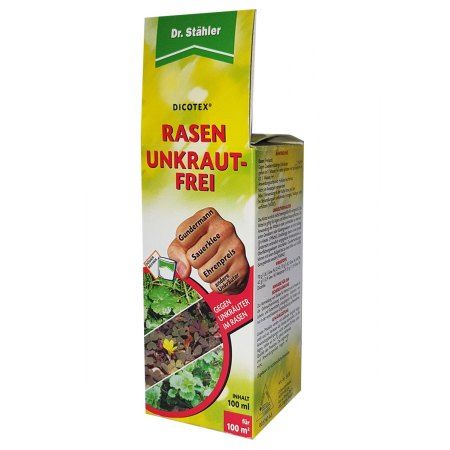
Dicotex Dr. Stahler Selective Weedkiller for Lawns and Grass 100ml
Dicotex Dr. Stahler Selective Weedkiller for Lawns and Grass 100ml
Selective weedkiller: safe for lawns
Removes broadleaf weeds (dandelions, clover, plantain...) without harming the grass.
- Format: Concentrate: dilute in water before use
- Area treated: up to 100 m²
Rough estimate based on the area stated by the manufacturer. Follow the dosage on the label.
Couldn't load pickup availability
VAT invoice sent automatically by email · Tracked shipping (DHL, UPS, bpost, Colissimo)
Dicotex is a professional water-soluble concentrated herbicide
Dr. Stähler Dicotex Unkraut-Frei is a growth herbicide for controlling weeds in lawns and contains four active ingredients which are absorbed both by the leaves and, to a lesser extent, by the roots of the weeds, and then distributed systemically throughout the plant.
The 4-component mixture of Dr. Stähler Dicotex Weed-Free provides a very broad spectrum of effectiveness, allowing for the efficient control of common and easy-to-manage weeds such as dandelions, daisies, and white clover, as well as problematic weeds like ground ivy and speedwell. Furthermore, Dr. Stähler Dicotex Weed-Free is very well tolerated by lawns. It is harmless to bees and can therefore be used without restriction, even on flowering weeds.
Active ingredients:
70 g/l (6.5% by weight) 2,4-D, 70 g/l (6.5% by weight) MCPA, 42 g/l (3.9% by weight) Mecoprop-P, 20 g/l (1.9% by weight) Dicamba / Approval Number: 005747-63
Do not allow application liquids and their residues, agents and their residues, empty containers or packaging, as well as cleaning and rinsing liquids, to enter waterways. This also applies to indirect discharges via sewers, gutters, and storm and wastewater pipes (NW468).
The following provisions also apply to application by spraying:
The product must be applied at a distance of at least 20 m from adjacent areas (excluding agricultural or horticultural areas, roads, paths and squares) using a loss reduction device listed in the "Loss Reduction Devices" list of October 14, 1993 (Federal Official Journal No. 205, p. 9780) in the currently valid version, with a drift reduction class of at least 90%. When applying the product, the use of loss-reducing technology is not necessary if the application is carried out using portable plant protection equipment or if the adjacent areas (e.g. field edges, hedges, wooded areas) have a width of less than 3 m or if the application of the product takes place in an area which has been designated by the Federal Centre for Biological Research in the "List of small regionalized structures" of 7 February 2002 (Federal Official Journal No. 70a of 13 April 2002) in the currently valid version as an agricultural landscape with a sufficient proportion of small structures (NT103).
Application for growing ornamental plants in lawns (outdoors):
Against broadleaf weeds: 100 ml/100 m² added to 100 l/100 m² of water, applied to each clump or individual plant.
Application timeframe:
Dicotex can be applied to lawns throughout the growing season (from April to September)
Effect in spring:
In spring, Dicotex is particularly effective against weeds such as autumn crocus or dock, as the plants are freshly grown and particularly sensitive at this time.
Effect in autumn:
Autumn application is particularly effective on wild carrots and daisies. These plants are susceptible to Dicotex in autumn.
Preparation and follow-up:
The lawn should not be mowed for at least 4 days before and 4 days after treatment so that enough active ingredients can be absorbed by the weeds.
Dosage:
Watering can (with watering nozzle): 10 ml of Dicotex in 10 l of water is enough for 10 m² of lawn.
Backpack sprayer: 200 ml of Dicotex in 20 liters of water is sufficient for 200 m² with a maximum of 1 application. 100 ml of Dicotex in 10 liters of water is sufficient for 100 m² with a maximum of 1 application. 50 ml of Dicotex in 5 liters of water is sufficient for 50 m² with a maximum of 1 application.
Application time :
During the growing season, from April to September. Do not use in the year of sowing. Maximum 1 application per crop or per year. Water at a rate of 1,000 l/1,000 m² of water.
Application time:
From spring to autumn. Do not use in the year of sowing. Maximum 1 application per crop or per year. Do not fertilize crops/cuts produced in the year of treatment (VV207).
Spectrum of action:
Swiss mustard, rushes, broadleaf plantain, stinging nettle, sweet clover, cinquefoil, speedwell, lambsquarters, daisy, ragged robin, common groundsel, amaranth, bird's-foot trefoil*, sorghum, ground ivy, wild radish, shepherd's purse, chickweed, groundsel, sheep's sorrel, cleavers, bulbous buttercup, spear thistle, creeping buttercup, dandelion, orache, common plantain, ribwort plantain, kale, wood sorrel*, yarrow, knotweed, chickweed, white clover, vetch, wild carrot, bindweed
*Note: Efficacy against birdsfoot trefoil and wood sorrel is not always guaranteed. In cases of difficult control, we recommend increasing the concentration of the irrigation solution to 2 ml per liter of water and watering the weeds individually. Be careful not to exceed the total permitted dose of 1 ml/m².
Compatibility of ornamental and sports turf plants:
Due to the diversity of grass varieties, incompatibilities cannot be ruled out in the year of sowing. Therefore, Dicotex can only be used from the first year of growth.
Preparation of the spray mixture:
Add the required amount of Dicotex (100 ml/100 m²) to half of the watering or spraying solution. Water consumption is 100 l/100 m² for watering and 10 l/100 m² for spraying. Top up with the remaining water and mix the watering or spraying solution thoroughly. Recommended water consumption for watering lawns: 100 l/100 m² and for spraying: 10 l/100 m².
Important information: Dicotex should be applied during the growing season, in good weather (between 15°C and 25°C), and when the foliage is well-developed. To ensure the product's effectiveness, make sure to spread it evenly. Do not apply immediately after mowing (wait at least 5 days). When using Dicotex, the leaves must be dry, and the area must remain dry for several hours (6 hours) after application. Weeds such as white clover show visible changes after just a few days. For other weeds such as speedwell and plantain, it may take several weeks to see a final result. However, the next mowing can take place approximately 5 days after applying Dicotex.
Use only on lawns:
Do not apply in the immediate vicinity of ornamental or broad-leaved cultivated plants or non-ornamental plants that should not be controlled and should not come into contact with the product.
Cleaning:
After use, thoroughly clean the spraying equipment on unstabilized soil, first with water, then with a detergent solution. Apply cleaning water to the treated area. Thoroughly clean the sprayer and hoses with water after use. To do this, fill the water tank to approximately 20% capacity and spray the inside of the tank with a jet of water. Run the agitator for about 2 minutes. Then, with the agitator running, spray the cleaning liquid through the nozzles onto the treated area. Regular cleaning of the sprayer's exterior, especially the spray solution tank, pump, and boom, should be part of normal operating procedures and, if possible, carried out directly in the field. Equipment manufacturers offer suitable upgrade kits that include water storage tanks and cleaning brushes. Always clean the sprayer immediately after spraying to prevent it from drying out. During internal cleaning, also check all connections and hoses, and when subsequently emptying the sprayer, completely empty the spray boom on the ground. Waiting time for lawns: The waiting time is covered by the application conditions and/or the remaining growing season between application and use (e.g., harvesting), or defining a waiting time in days is not necessary.
Environmental behavior
Bees:
The product is classified as not hazardous to bees up to the highest application rate specified in the authorization or, if no application rate is specified, up to the application concentration (B4) (NB6641).
Beneficial organisms:
The product is classified as non-harmful to populations of the species Pardosa amentata and palustris (wolf spiders) (NN130). The product is classified as non-harmful to populations of the species Poecilus cupreus (ground beetle) (NN165).
Instructions for safe handling:
To avoid risks to humans and the environment, it is imperative to follow the instructions for use (SP001).
Frequently asked questions
Can I use it on my lawn?
When should I treat?
When can I mow?
What if it rains after treatment?
Children and pets
Delivery and payment
Use plant protection products safely. Always read the label and product information before use.
Share
