



Mortengo
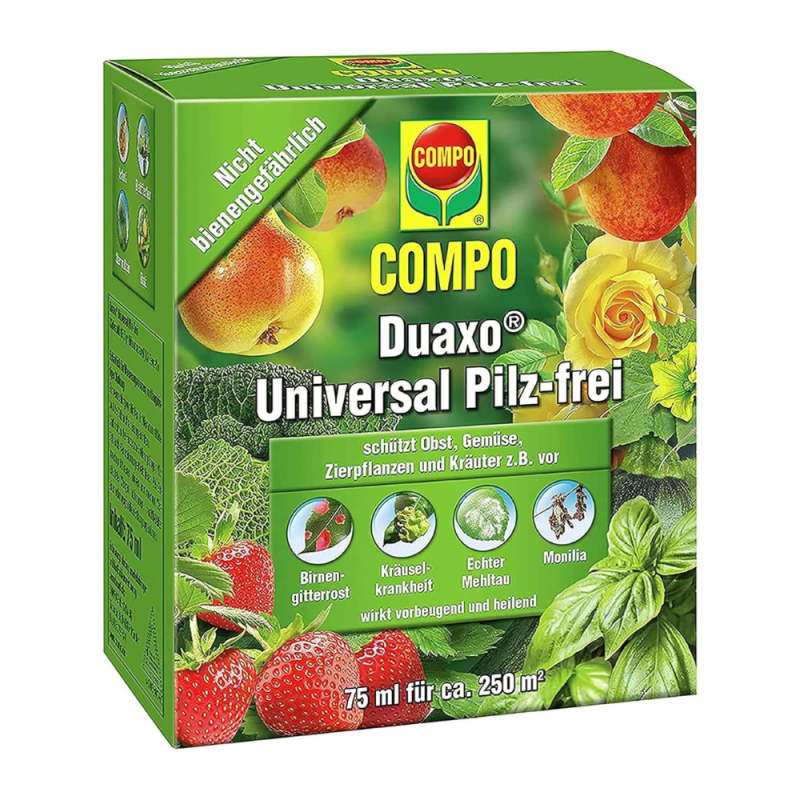
Compo Duaxo Universal Antifungal Without Fungi 75 ml
Couldn't load pickup availability
- Fungicide concentrate against powdery mildew, pear rust, leaf curl, rust, scab, cane dieback and leaf spots
- For use on more than 30 crops
- Stops the spread in already infected leaves
- Long-lasting effect thanks to the deposit effect
- Very economical: 150 ml is enough for 500 m²
A versatile fungicide effective against, for example, pear rust, leaf curl, brown rot, rust, scab, leaf spots, black spot, powdery mildew, and other fungal diseases on roses, ornamental plants, and shrubs, as well as on fruit and vegetable crops. Suitable for greenhouses and gardens. Stops the spread of disease in already infected leaves and protects against new infestations.
Recommended use
Dilute Duaxo Universal Fungus-free with water according to the dosage instructions and spray evenly on the plants. Leaves should be dried beforehand. It is best to apply it in the evening. Depending on the disease, injections should be administered at different times and frequencies. Use a standard garden sprayer and, if possible, also treat the undersides of the leaves. For larger trees, specialist retailers offer extension tubes. To avoid drift, do not spray in windy conditions. Always inject early, only at the full approved concentration, and not too frequently.
Application period
January to December
Instructions for use
Additional information on usage
Use permitted in allotment and community gardens!
Use permitted by non-professional users.
To combat scab in pome fruits, we recommend using COMPO Mildew-free Kumulus® WG before flowering and Duaxo Universal Fungus-free after flowering. Scab can only infect if the leaves are continuously wet for at least 9 hours. Only then are sprays necessary. Duaxo Universal Fungus-free is characterized by its long-lasting effect and excellent efficacy against scab.
Leaf curl disease on peach, apricot, and nectarine trees: For successful treatment, the correct spraying dates, depending on the weather and leaf bud development, are important. We recommend three treatments. The first application should be made as soon as the leaf buds on the one-year-old shoots begin to swell. Note – depending on the weather, this could be as early as December, January, or February! Follow-up treatments: During rainy periods with average daily temperatures above 8°C (46°F), sprays should be repeated every 10 days (do not spray during rain, but wait until the leaves are dry; the last treatment should be carried out after bud break, when the green tips of the leaves are visible). Branches must be dry at the time of spraying. In dry conditions and temperatures below 8°C (46°F), spraying can be delayed.
Raspberry dieback: Treatment of young canes (from 20 cm in length) of summer varieties should be carried out after harvest (after removal of the fruiting canes) until before flowering the following year. For autumn varieties, where all canes are cut down to ground level after harvest, we recommend treatment until before flowering the following year (from a cane length of 20 cm). Especially in areas with frequent rainfall, three treatments should be applied to the young shoots at intervals of 7 to 14 days. Control is only effective when combined with cultural practices.
For example, in the case of vigorous varieties, the first shoot of the canes must be removed. Similarly, injuries to young shoots, waterlogging, overly dense plant populations, and the presence of tall weeds must be avoided. Balanced cane growth (irrigation, fertilization) must be ensured. We recommend using COMPO Berry slow-release fertilizer. Diseased canes must be cut down and destroyed.
Application period:
At the beginning of the infestation or when the first symptoms/parasites become visible.
Waiting time:
- Apple, pear, beetroot, swede, sour cherry, sweet cherry, plum: 28 days
- Cucumber and zucchini: 3 days; fresh herbs: 14 days
- Other vegetables: 21 days
- Apricot, nectarine, peach, asparagus, strawberry, raspberry: The waiting time is covered by the application conditions and/or the remaining vegetation period between application and use (e.g. harvest) or setting a waiting time in days is not necessary.
- Ornamental plants, ornamental trees (including roses): None
Areas of application
Powdery mildew: apple, pear
Pear tree rust: Pear (exterior)
Leaf curl disease: peach, apricot, nectarine (outdoors)
Rust: Plum (exterior)
Monilia laxa: sour cherry, sweet cherry, plum (ornamental trees)
White spot disease, red spot disease: strawberry (post-harvest; outdoors)
Cane dieback, raspberry rust*: Raspberry (exterior)
Powdery mildew: cucumbers, courgettes (greenhouse)
Leaf spot, stem burn: cucumbers, courgettes (outdoors)
Rust, leaf disease: asparagus (outdoors)
Leaf spots: beetroot (outdoors)
Powdery mildew, fungal spots on leaves: swede (outdoors), parsnip (outdoors), parsley root (outdoors), salsify (outdoors), horseradish (outdoors)
Powdery mildew, rust, fungal spots on leaves: fresh herbs (outdoors)
Black spot of carrot, black rot, powdery mildew, leaf spot disease (leaf infection): Carrot (outdoors)
Leaf spot (Septoria species): celeriac, celeriac (outdoors), leek (outdoors)
Black spot, ring spot disease: headed cabbage (outdoors; red, white, pointed and Savoy cabbage), cauliflower,
Broccoli (outdoors)
Black rot, ring spot, powdery mildew: Pak Choi, Chinese cabbage (outdoors)
Purple spot: edible onion (outdoors; to be used as a dry onion)
* This disease is included based on our own experience when used in the specified application areas.
Quantity/dosage/application
Use the measuring cup provided for dosing. Rinse thoroughly with water after use and add rinse water to the spray solution. Always prepare only the required amount of spray liquid. Mix or shake the prepared spray mixture well and use it the same day.
Dosage information
Areas of application; diseases; Concentration and quantity of spraying**; Application deadlines
1. Ornamental plants (open field and greenhouse); Powdery mildew, rust, leaf spots; 10 ml in 1 liter of water (see spray quantity below); From the appearance of the first symptoms, spray repeatedly at 8 to 14 day intervals; max. 3 applications
2. Roses (outdoors); Black spot, powdery mildew+, rust+, leaf spots+ 10 ml in 1 liter of water (see spray quantity below); From the appearance of the first symptoms, spray repeatedly at 10-14 day intervals; max. 3 applications
3. Apple, pear (outdoors); Scab: 3 ml in 1 liter of water per 27 m² per meter of crown height; From the mouse-ear stage: green leaf tips extend 10 mm beyond the bud scales; first leaves spread to fruit diameter up to 40 mm; fruit is upright; T stage: The base of the fruit and the stem form a T. Spray repeatedly at 10-20 day intervals if the leaves have been wet for more than 9 hours; max. 4 applications
4. Apple, pear (outdoors); Powdery mildew; 3 ml in 1 liter of water per 27 m² per meter of crown height. As soon as the first symptoms appear, spray several times at 10- to 14-day intervals; max. 4 applications
5. Pear (outdoors); pear-shaped trellis; 3 ml in 1 liter of water per 27 m² per meter of crown height; from the emergence of the first leaves, up to 4 treatments at 10-14 day intervals; max. 4 applications
6. Peach, apricot, nectarine (outdoors); curl disease; 3 ml in 1 liter of water per 27 m² per meter of crown height; From the beginning of bud swelling (leaf buds): light brown bud scales visible; The edges of the bud scales show light areas (around late February/early March) until the leaf buds have green tips: the brown bud scales fall off; Bud surrounded by light green bracts. Repeat every 10 days during this period
Inject; max. 3 applications. Treatment may be necessary as early as December. See additional notes below.
7. Sweet and sour cherries, plums (outdoors); Moniliosis, cherry leaf brown, cherry scab; 3 ml in 1 liter of water per 27 m² per meter of crown height; Spray at the beginning of flowering (first flower open), at full bloom, and at the end of flowering (all petals fallen); max. 3 applications
8. Plum (outdoors); Rust; 3 ml in 1 liter of water per 27 m² per meter of crown height; From the appearance of the first symptoms (around the end of July), 2 to 3 sprays at 10-14 day intervals. Treat early plums only after harvest; max. 3 applications
9. Strawberries (in the year of planting or after harvest; in open fields); White spot disease, red spot disease; 12 ml in 2 liters of water per 20 m²; serial treatment; From the appearance of the first symptoms, inject several times at intervals of 7 to 14 days; max. 2 applications
10. Raspberry (after harvest, until before flowering; outdoors); Cane dieback, raspberry rust*; 6 ml in 1 liter of water per 10 m²; As soon as the first symptoms appear, inject several times at intervals of 7 to 14 days; max. 3 applications
11. Cucumbers, courgettes (greenhouse); Powdery mildew, leaf spots, stem blight; 10 ml in 1 liter of water (see spray quantity below); As soon as the first symptoms appear, spray repeatedly at 10-14 day intervals; max. 3 applications
12. Cucumbers, courgettes (outdoors); Powdery mildew, leaf spots, stem blight; 10 ml in 1 liter of water (see spray quantity below); As soon as the first symptoms appear, spray repeatedly at 10-14 day intervals; max. 3 applications
13. Asparagus (outdoors); rust, leaf disease; 10 ml in 1 liter of water (spraying quantity see below); From the appearance of the first symptoms, inject repeatedly at intervals of 14 to 21 days; max. 3 applications
14. Beetroot (outdoors); leaf spots; 10 ml in 1 liter of water (spraying quantity see below); From the appearance of the first symptoms, inject repeatedly at intervals of 10 to 14 days; max. 3 applications
15. Swedish (outdoor); Powdery mildew, leaf spots; 10 ml in 1 liter of water (spraying quantity see below); From the appearance of the first symptoms, inject repeatedly at intervals of 10 to 14 days; max. 3 applications
16. Fresh herbs (outdoors); Powdery mildew, leaf spots, rust*; 10 ml in 1 liter of water (see spray quantity below); As soon as the first symptoms appear, spray repeatedly at 10-14 day intervals; max. 2 applications
17. Carrot (outdoors); Black spot of carrot, black rot, powdery mildew, leaf spot (foliar infestation); 10 ml in 1 liter of water (see spray quantity below); From the appearance of the first symptoms, spray repeatedly at intervals of 14 to 21 days; max. 3 applications
18. Celeriac, celeriac (outdoors); Leaf spots (Septoria species); 10 ml in 1 liter of water (see spray quantity below); From the appearance of the first symptoms, spray repeatedly at 10-14 day intervals; max. 3 applications
19. Head cabbage (field-grown; red, white, pointed, and Savoy cabbage); black spot disease, ring spot disease; 10 ml in 1 liter of water (see spray quantity below); From the appearance of the first symptoms, spray repeatedly at 14- to 21-day intervals; max. 3 applications
20. Brussels sprouts (outdoors) powdery mildew; 10 ml in 1 liter of water (spraying quantity see below); From the appearance of the first symptoms, spray repeatedly at intervals of 14 to 21 days; max. 3 applications
21. Cauliflower, broccoli (outdoors); black spot disease of cabbage, ring spot disease; 10 ml in 1 liter of water (see spray quantity below). From the appearance of the first symptoms, spray repeatedly at 14- to 21-day intervals; max. 3 applications
22. Pak Choi, Chinese cabbage (outdoors); Black spot, black rot, ring spot, powdery mildew; 10 ml in 1 liter of water (see spray quantity below); From the appearance of the first symptoms, spray repeatedly at 10-14 day intervals; max. 3 applications
23. Parsnips (outdoors); Powdery mildew, leaf spots; 10 ml in 1 liter of water (spraying quantity see below); From the appearance of the first symptoms, spray repeatedly at intervals of 14 to 21 days; max. 3 applications
24. Parsley leaf spots (outdoors), powdery mildew; 10 ml in 1 liter of water (spraying quantity see below); From the appearance of the first symptoms, spray repeatedly at intervals of 14 to 21 days; max. 3 applications
25. Black Salsify (outdoors); Leaf spot disease (Septoria species); 10 ml in 1 liter of water at intervals of 10 to 14 days; max. 3 applications; From the appearance of the first symptoms, inject repeatedly at intervals of 14 to 21 days; max. 3 applications
26. Horseradish (outdoors); Leaf spot disease (Septoria species); 10 ml in 1 liter of water at intervals of 10 to 14 days; max. 3 applications; From the appearance of the first symptoms, inject repeatedly at intervals of 14 to 21 days; max. 3 applications
27. Leek (outdoors); Leaf spots (Septoria species); 10 ml in 1 liter of water (see spray quantity below). As soon as the first symptoms appear, spray repeatedly at 10-14 day intervals; max. 3 applications
28. Edible onion (outdoors; used as a dry onion); purple spot disease; 10 ml in 1 liter of water (see spray quantity below); From the appearance of the first symptoms, spray repeatedly at intervals of 7 to 14 days; max. 3 applications
29. Ornamental trees (outdoors); Moniliosis tip blight; 22 ml in 1 liter of water (spraying quantity see below). Occasionally, the first flowers open until the end of flowering: fruit set is visible; max. 3 applications
30. Ornamental trees (outdoors); Gall; 22 ml in 1 litre of water (spraying quantity see below); From the 1st leaf or pair of leaves or whorl unfurled; The first leaves unfurl, spray several times at intervals of 10 to 20 days if the leaves have been wet for more than 9 hours; max. 3 applications.
+ Diseases are also covered by the approval for ornamental plants.
* Diseases are recorded based on our own experience when used in the specified application areas (side effects) /
** Application rate
The amount of liquid to spray depends on the height of the plant:
Vegetables and herbs outdoors:
600 ml of sprayed liquid covers 10 m²
Cucumbers in a greenhouse:
Plant size up to 50 cm: 600 ml of spray solution per 10 m²
Plant size 50-125 cm: 900 ml of spray solution per 10 m²
Plant size greater than 125 cm: 1200 ml of spray solution per 10 m²
Roses and other ornamental plants in open fields and greenhouses: Plant size up to 50 cm: 450 ml of spray solution per 10 m²
Plant size 50-125 cm: 600 ml of spray solution per 10 m²
Plant size greater than 125 cm: 750 ml of spray solution per 10 m²
Outdoor ornamental trees:
Plant size up to 50 cm: 250 ml of spray solution per 10 m²
Plant size 50-125 cm: 625 ml of spray solution per 10 m²
Plant size greater than 125 cm: 1500 ml of spray solution per 10 m²
With repeated use of this product or products from the same active ingredient group or those exhibiting cross-resistance, a reduction in efficacy may occur or has already occurred. To prevent the development of resistance, alternate this product with products from other active ingredient groups that do not exhibit cross-resistance. If in doubt, consult a healthcare professional.
For application areas 1 to 3 and 11 to 30, the following provisions apply: the maximum number of applications is limited due to the specific nature of the active ingredient. Therefore, adequate control throughout the growing season cannot be guaranteed in all cases. If necessary, use products containing other active ingredients subsequently or alternately. For this purpose, we recommend using COMPO Ortiva Spezial Fungus-free or COMPO Bio Mildew-free Thiovit Jet, if they are approved for the intended application.
Environmental information
The agent is toxic to algae, fish, and fish feed. The product is classified as non-harmful to populations of the species Pardosa amentata and palustris (wolf spiders), Typhlodromus pyri (predatory mite), Orius laevigatus (flower bug), Poecilus cupreus (ground beetle), Chryoperla carnea (lacewing), and Aphidius rhopalosiphi (braconid wasp); as slightly harmful to populations of the species Coccinella septempunctata (seven-spotted ladybird); and as harmful to populations of the species Trichogramma cacoeciae (chalcid wasp). The product is classified as non-hazardous to bees up to the highest application rate or concentration specified in the authorization (B4).
This product information does not replace adherence to the instructions for use. Use pesticides with care. Always read the label and product information before use. Please note the warnings and symbols in the instructions.
Product details
Storage/Shelf Life
Waste storage and disposal:
Store in a cool, dry place, but protect from frost, only in the original, unopened packaging. Dispose of empty containers in the recycling bin. Dispose of containers containing product residue at household chemical collection points.
Return. Do not reuse the original packaging or empty containers.
Plant compatibility
Duaxo Universal Fungus-free is very well tolerated by plants. No sensitive plant species or varieties are known. On hot days, apply only in the evening. As there can be significant differences between varieties, compatibility should be tested on a few flowers and leaves before treating larger stocks or valuable individual plants. Observation period: 10 days.
Technical information/markings
Fully systemic fungicide | Active ingredient: Difenoconazole
Plant protection product group: Fungicide
Active ingredient: Difenoconazole
Active ingredient content of the product: 16.7 g/l
German registration number: 006300-60
Austrian registration number: 3346-0
Share
