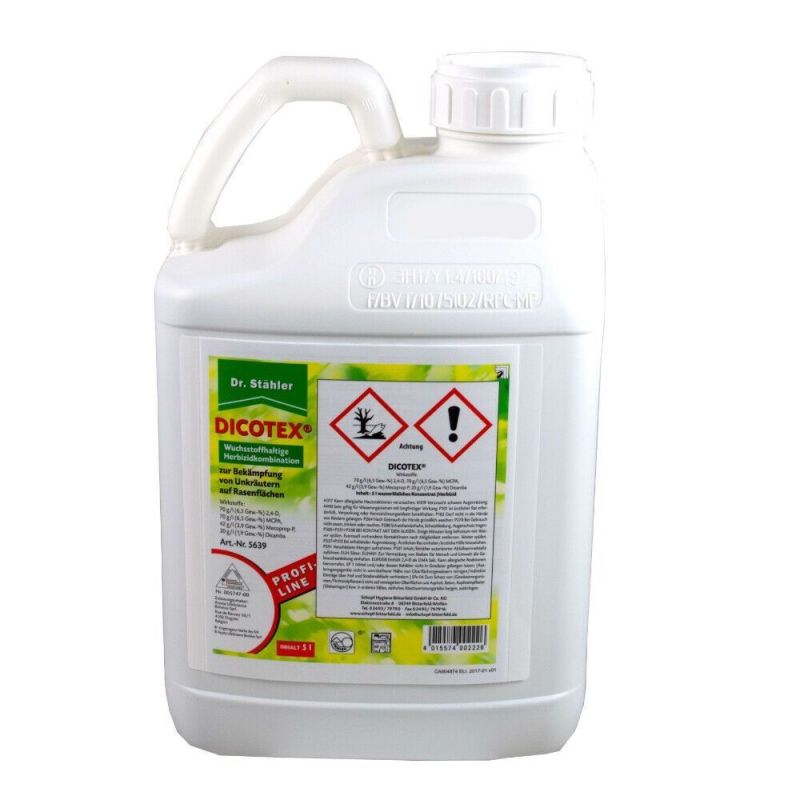
Dicotex Dr. Stähler Powerful Selective Lawn Weed Killer - 5 L
Dicotex Dr. Stähler Powerful Selective Lawn Weed Killer - 5 L
Selective weedkiller: safe for lawns
Removes broadleaf weeds (dandelions, clover, plantain...) without harming the grass.
- Format: Concentrate: dilute in water before use
- Area treated: up to 5000 m²
Rough estimate based on the area stated by the manufacturer. Follow the dosage on the label.
Couldn't load pickup availability
VAT invoice sent automatically by email · Tracked shipping (DHL, UPS, bpost, Colissimo)
Dicotex is a water-soluble concentrated herbicide for professional use
- Dr. Stähler Dicotex Weed-Free is a growth-promoting herbicide for controlling weeds in lawns and contains four active ingredients that are absorbed both through the leaves and, to a lesser extent, through the roots of the weeds, and then distributed systemically throughout the plant.
- The quadruple mixture in Dr. Stähler Dicotex Weed-Free ensures a very broad spectrum of action, so that in addition to common and easy-to-control weeds such as dandelions, daisies, and white clover, problematic weeds such as ground ivy and speedwell are also safely controlled. At the same time, Dr. Stähler Dicotex Weed-Free exhibits very good lawn compatibility. Dr. Stähler Dicotex Weed-Free is not harmful to bees and can therefore be used without restriction, even on flowering weeds.
Active ingredients:
- 70 g/l (6.5% by weight) 2,4-D, 70 g/l (6.5% by weight) MCPA, 42 g/l (3.9% by weight) Mecoprop-P, 20 g/l (1.9% by weight) Dicamba / Approval number: 005747-63
- Do not allow application liquids and their residues, agents and their residues, empty containers or packaging, or cleaning and rinsing liquids to enter watercourses. This also applies to indirect inputs via the sewer system, courtyard and street drains, as well as storm drains and sewer systems (NW468).
The following provisions also apply to spray application:
The product must be applied at a distance of at least 20 m from adjacent areas (excluding agricultural or horticultural areas, roads, paths, and squares) using loss-reducing equipment listed in the "Loss-reducing Equipment" list of October 14, 1993 (Federal Gazette No. 205, p. 9780) in its currently valid version, with a drift reduction class of at least 90%. When applying the product, the use of loss-reducing technology is not necessary if the application is carried out using portable plant protection equipment or if the adjacent areas (e.g., field margins, hedges, wooded areas) are less than 3 m wide or if the application of the product takes place in an area that has been designated by the Federal Biological Research Centre in the "List of Regionalized Small Structures" of February 7, 2002 (Federal Gazette No. 70a of April 13, 2002) in its currently valid version as an agricultural landscape with a sufficient proportion of small structures (NT103).
Application crop of ornamental plants lawn (outdoor):
Against dicotyledonous weeds: 100 ml/100 m² poured in 100 l/100 m² of water as a patch treatment or on individual plants
Application time:
Dicotex can be applied to lawns throughout the growing season (from April to September)
Effect in spring:
In spring, Dicotex is particularly effective against weeds such as autumn crocus or dock, because the plants are newly grown and particularly sensitive at this time.
Effect in autumn:
Autumn application works particularly well on wild carrot or daisies. These plants are sensitive to Dicotex in autumn.
Preparation and follow-up:
The lawn should not be mowed at least 4 days before and 4 days after the treatment so that enough active ingredients can be absorbed by the weeds.
Dosage:
- Watering can (with spray attachment): 10 ml of Dicotex in 10 l of water is enough for 10 m² of lawn.
- Knapsack sprayer: 200 ml of Dicotex in 20 l of water is enough for 200 m² with a maximum of 1 application. 100 ml of Dicotex in 10 l of water is enough for 100 m² with a maximum of 1 application. 50 ml of Dicotex in 5 l of water is enough for 50 m² with a maximum of 1 application.
Time of application :
during the growing season, from April to September. Do not use in the year of sowing. Max. 1 application per crop or per year. Pour 1000 l/1000 m² of water,
Time of application:
From spring to autumn. Do not use in the year of sowing. Max. 1 application per crop or per year. Do not feed harvested/mown material in the year of treatment (VV207).
Spectrum of action:
Field mustard, rushes, broadleaf plantain, brown knapweed, melilot, cinquefoil, speedwell, goosefoot, daisy, cuckooflower, groundsel, common amaranth, bird's-foot trefoil*, common sorrel, ground ivy, wild radish, shepherd's purse, chickweed, ragwort, sheep's sorrel, cleavers, bulbous buttercup, spear thistle, creeping buttercup, dandelion, saltbush, common plantain, ribwort plantain, common curled dock, wood sorrel*, yarrow, knotgrass, common chickweed, white clover, vetch, wild carrot, bindweed
*Note: Efficacy against bird's-foot trefoil and wood sorrel is not always certain. If control is difficult, it is recommended to increase the concentration of the watering solution to 2 ml per liter of water and water the weed patches individually. Ensure that the maximum authorized application rate of 1 ml/m² is not exceeded.
Plant compatibility ornamental and sports lawn:
Due to the diversity of varieties, incompatibilities cannot be excluded for certain grass varieties in the year of sowing. Therefore, Dicotex can only be used from the first year of growth.
Preparation of the spray mixture:
- Add Dicotex in the required quantity (100 ml/100 m²) to half of the watering or spray solution. The water consumption for the pouring method is 100 l/100 m², for the spraying method it is 10 l/100 m². Fill with the remaining amount of water, water or. Mix the spray mixture well. Recommended water application rate Lawn/watering method 100 l/100 m² Lawn/spraying method 10 l/100 m²
- Water with a watering rake, sprinkler, or sprayer over well-developed weeds or those at the rosette stage.
Important information:
Dicotex should be applied during the growing season in growing weather (from 15 °C to 25 °C) and when the foliage is well developed, ensuring it is distributed evenly to ensure effective results.
Do not apply shortly after mowing (wait at least 5 days). When using Dicotex, the leaves must be dry and must remain dry for a few hours (6 hours) after application.
Weeds like white clover show visible changes after just a few days. For other weeds such as speedwell and plantain species, it may take several weeks to achieve the final control result. However, the next lawn mowing can take place approximately 5 days after applying Dicotex.
Use only on lawns:
Do not apply in the immediate vicinity of broad-leaved ornamental or cultivated plants or non-ornamental plants that should not be controlled and should not come into contact with the product.
Cleaning:
After use, clean the watering equipment thoroughly on unsealed surfaces, first with water and then with a detergent solution.
Apply cleaning water to the previously treated area. Clean the sprayer and pipes thoroughly with water after use. To do this, fill about 20% of the tank volume with water and spray the inside of the tank with the water jet. Turn on the agitator for about 2 minutes. Then, while the agitator is running, spray the cleaning liquid through the nozzles onto the previously treated area.
Regular cleaning of the outside of the plant protection sprayer, especially the spray tank, pump, and boom, should be part of the normal operating procedure and, if possible, should be done directly in the field. For this purpose, equipment manufacturers offer suitable upgrade kits with water storage tanks and cleaning brushes.
Always clean the sprayer immediately after spraying to prevent it from drying. When cleaning the inside, also pay attention to all fittings and hoses and, during spraying, empty the spray boom completely in the field.
Waiting time for lawns: The waiting time is covered by the application conditions and/or the remaining growing season between application and use (e.g., harvest), or the definition of a waiting time in days is not necessary.
Environmental behavior
Bees:
The product is classified as non-hazardous to bees up to the highest application rate specified in the authorization or, if no application rate is specified, up to the application concentration (B4) (NB6641).
Beneficial organisms:
The product is classified as non-harmful to populations of the species Pardosa amentata and palustris (wolf spiders) (NN130). The product is classified as non-harmful to populations of the species Poecilus cupreus (ground beetle) (NN165).
Aquatic plants:
The agent is toxic to higher aquatic plants (NW265).
Algae:
The agent is toxic to algae (NW262).
Water/Groundwater:
The use of the product in or in the immediate vicinity of surface waters or coastal waters is not permitted (Section 6, Paragraph 2, PflSchG). Regardless of this, the minimum distance from surface waters provided by state law must be maintained. Infringements may be punished with a fine of up to 50,000 euros (NW642).
Storage:
Store separately from human and animal food, out of the reach of children, and only in the sealed original packaging.
Instructions for safe handling:
To avoid risks to humans and the environment, it is imperative to follow the instructions for use (SP001).
User protection:
Avoid unnecessary contact with the product. Misuse can lead to health damage (SB001).
The directive regarding requirements for personal protective equipment in the field of plant protection "Personal Protective Equipment when Handling Plant Protection Products" of the Federal Office of Consumer Protection and Food Safety (SB110) must be observed.
Wear well-fitting safety goggles when handling the undiluted product (SE110). Re-entry into treated areas/crops on the day of application is only possible with the personal protective equipment specified for the application of the product.
Follow-up work on/in treated areas/crops can generally only be carried out 24 hours after application of the product. Within 48 hours, the pesticide protection suit and universal protective gloves (plant protection) must be worn (SF1891).
When performing follow-up work on freshly treated plants, work clothing (at least a long-sleeved shirt and long pants) and gloves must be worn (SF190). Use of treated lawns as playgrounds and lawns only after the next cut (SF243).
Wear universal protective gloves (plant protection) when handling the undiluted product (SS110). Wear pesticide protection clothing and sturdy shoes (e.g., rubber boots) when handling the undiluted product (SS2101).
Wear pesticide protection clothing and sturdy shoes (e.g., rubber boots) when applying/handling the ready-to-use product (SS2202). Wear a rubber apron when handling the undiluted product (SS610).
Labeling GefStoffV R 43: Possible sensitization by skin contact. R 51/53: Toxic to aquatic organisms, may cause long-term adverse effects in the aquatic environment.
S 2: Keep out of reach of children.
S 13: Keep away from food, drink, and animal feeding stuffs.
S 23: Do not breathe vapors/aerosols.
S 24: Avoid contact with the skin.
S 35: Waste and its container must be disposed of in a safe way.
S 36/37: Wear suitable protective clothing and gloves when working.
S 46: If swallowed, seek medical advice immediately and show this container or label.
S 51: Use only in well-ventilated areas.
S 57: Use appropriate container to avoid environmental contamination.
Contains 2,4-D. May produce an allergic reaction.
To avoid risks to human health and the environment, comply with the instructions for use. - SP001 Do not reuse container.
By purchasing this product, you confirm that:
- 1. you possess the necessary expertise,
- 2. the product will only be used on cultivated surfaces (or you will send us a permit)
- 3. you will apply plant protection products in accordance with the corresponding instructions for use.
- Furthermore, all plant protection products may only be applied on surfaces used for horticulture, agriculture, or forestry without special authorization in accordance with Article 6 (3) of the Plant Protection Act, and not on uncultivated surfaces (e.g., parking areas, courtyards, paths, and paved areas, etc.).
Safety data sheet available on request for professional users.
Frequently asked questions
Can I use it on my lawn?
When should I treat?
When can I mow?
What if it rains after treatment?
Children and pets
Delivery and payment
Use plant protection products safely. Always read the label and product information before use.
Share